Thursday, September 15, 2011

Own Work Sample: Notes on Ecology

Ecology is the study of the relations that living organisms have with each other.

There are many different levels of Ecology.
1.Individual
2.Population (individuals of same species)
3.Community (collected of populations)
4.Ecosystem (habitat + community = ecosystem)
5.Biome
6.Biosphere

Illustrated:


Examples of Biomes: Tropical Rainforest, Tundra, Desert, Savannah, Kelp forest

----------------------------------------------------------------------------

Factors Influencing Ecology:


Abiotic Factor

Temperature
Rainfall
Light Intensity
Salinity (salt content)

Secondary

Wind speed
Humidity
Wave action
pH

Biotic Factors

Competition with other organisms
Abundance of prey
Presence of predator

--------------------------------------------------------------------------------
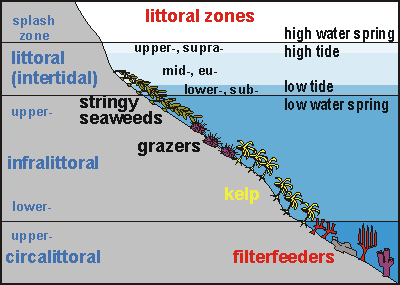
Example of a ROCKY SHORE System - ABIOTIC factor examples

Characteristics (abiotic factors)

-Highly Dynamic (subjected to wave action)
-Large variation in temperature, salinity, oxygen content, pH, water availability
-Predators gain easy access to rocky shore organisms when tides return
-Likewise, when tides recede, birds prey on exposed organisms

-TIDE ZONES-


Supratidal zone (above highest level of tide)
-Organisms that can move around
-Crabs
-Hate water (absorb humidity from sea water)

Intertidal zone (between lowest and highest level of tide)
-Able to withstand dehydration
-Barnacles have calcium shells which they hide in when it is too hot.
-They cling to the rocks tightly to avoid getting washed away.
-Robust osmoregulatary (salt level control) systems

Subtidal done (below lowest level of tide)
-Unable to withstand dehydration
-Seaweed


----------------------------------------------------------------------------------
Ecological Interactions: Commensalism, Mutualism,


Mutualism (+ +)
-Both organisms benefit from this interation

Commensalism (+ 0)
-One organism benefits from this interaction, and the other is not affected

Mutualism

Clownfish – Sea Anemone
-Sea Anemone provides protection for Clownfish
-Clownfish help clean up scraps of food in Sea Anemone

Ants – Aphids
-Ants protect aphids from other predators
-Aphids suck out juice from plants for ants

Egyptian plover – Crocodile
-Egyptian plover cleans the teeth of the crocodile
-Crocodile provides food for Egyptian plover (in teeth)

Cleaner Shrimps – Eels
-Cleaner shrimps cleans the fish
-Eels provide food for cleaner shrimps

---
Commensalism

Epiphytes (climbers, ferns) – Rain trees
-Epiphytes gets to be high up for sunlight

Cattle Egret – Cattle
-Cattle Egret eats worms off Cattle (worms do not affect Cattle)

Barnacles – Scallop
-Barnacles attach to Scallop

Remora – Shark
-Remora attaches to shark to move around without any effort
-Also offers protection

Own Work Sample: Biology Notes

Sexual Reproduction Notes
-All living things reproduce
>Reproduction is the biological process where new individuals (known as “ offsprings ”) are made from older ones (known as “parents”)
-Organisms reproduce by two primary means:
> Sexual Reproduction
Sexual reproduction is the biological process of forming a new individual through the fusion of two very specialized cells known gametes. The fusion process is also known as fertilization. In cases where the two gametes involved in the fusion are distinct in form and structure, the larger of the two gametes is known as the egg or ovum, while the smaller one is known as the sperm.

*eg. Mammals
>Asexual Reproduction
Asexual reproduction is the biological process of forming a new individual from a single parent without the fusion of gametes (i.e. without fertilization).
*eg. Amoeba
-Difference
>Asexual
-Does not Involve fusion of two reproductive cells
-Only one parent is required
-Identical Offspring

>Sexual
-Involve the fusion of two reproductive cells (gametes).
-Produces variation in offspring

-Stages
Puberty > Copulation > Fertilization > Post Fertilization > Child Birth (Back to Puberty)
Puberty
-Begins at the age of about 11 for girls and 13 for boys.
>Brain releases hormones > Ova and sperms develop > Ovaries and testicals produce female and male sex hormones > Secondary Sexual Characteristics
>Male (testosterone) LOL extra: Fito-oestragen
-11-15 yrs
-Growth of hair
-Growth of muscles / genitals
-Deepening of voice / Pimples
-Confusion, love/hate, and giggly excitement

>Female (oestragen)
-9-13 yrs
-Hair growth
-Development of breasts ad hips
-Menstruation
-Confusion, love/hate, and giggly excitement
Hormones

Anterior Pituitary Gland
1. Follicle Stimulating Hormone
>Primary follicles > Mature follicle
-Mature follicles
= Granulosa Cells, Oocyte (Egg).

Granulosa cell then excrete Estrogen

Organs
Male Female
Scrotum
>Production and development of sperms requires a temperature lower than body temperature, thus the scrotum hands the testes away from the body
Prostate Glands
Cowper’s gland


Copulation and Fertilisation
Copulation (Mating)
Male
1. -Sexual Arousal

2. -Arterioles (smaller versions of the artery) dilate in penis
-Blood enters erectile tissue faster than it can return to venous system
3. -Penis becomes stiff and erected
-Allow entry into vagina
4. -Insertion in vagina
-Release of semen into vagina
5. -Sperms swim through uterus and into oviduct
6. -300 to 500 million of sperms enter oviduct
-Only 1 will fertilize the egg


Embryonic Development Summary
-Zygote
>Undifferentiated ball of cells
>Implantation (into endometrium) takes place 3 to 4 days after fertilization
NEXT
-Embryo
>Simple tissue layers
(Separated tissue layers)
NEXT
-Foetus
>Recognizable Organs
(Endometrium thickens, rich with blood capillaries to nourish foetus)

Fetal “Membranes” (made up of a layer of cells)
-Amnion
>Enclosed amniotic fluid

**Yolk Sac to provide nutrients until placental vessels are stable
-Chorion
>placenta development
>Cells of chorion Fold to make the Chorionic Villi
>Increase surface area for absorption
>Capillary networks inside the villi carry the material away, maintain concentration gradients to facilitate diffusion of materials

Placenta
1. Exchange of nutrients, oxygen and waste between fetal and maternal blood.
2. Allows diffusion of protective antibodies
3. Produces progesterone which maintains the uterine lining
Amniotic Sac & Fluid
1. Supports and cushions fetus before birth
2. Absorbs shock
3. Not compressible thus prevent physical injury
4. Fetus can move freely
5. Lubricates vagina during delivery
Umbilical Cord
1. Umbilical arteries carries deoxygenated blood and waste products from fetus to placenta
2. Umbilical veins carry oxygenated blood and dissolved food

Science Review: AIDSs

STDs have become a widespread and global problem. The effects are serious and highly dangerous. AIDS is also at this point unable to be cured too. Hence, it is important to know the symptoms of STDs and how they can affect the body.

The STD I will be discussing today is AIDS (Acquired immune deficiency syndrome) as a result of the human immunodeficiency virus (HIV)

1. AIDS

The cause of AIDS is the human immunodeficiency virus (HIV). The cause of AIDS includes the spread of the HIV virus via sexual intercourse, contaminated needles, or blood transfusion. Another cause of AIDS is through the transmission of the HIV virus via breast milk, factor VIII concentrates, or accidental inoculation from patient to a health care worker.

Early symptoms include fever, headache, tiredness, nausea, diarrhea and enlarged lymph nodes in the neck, armpits or groin.

Later symptoms include rapid weight loss, dry cough, recurring fever, profuse nights sweats, profound and unexplained fatigue, swollen lymph glands in the armpits, groin, or neck, diarrhea lasting more than a week, blurred vision,white spots or unusual blemishes on the tongue, in the mouth, or in the throat, skin rashes or bumps, pneumonia, red, brown, pink, or purplish blotches on or under the skin or inside the mouth, nose, or eyelids, memory loss, depression, and other neurological disorders.

AIDS will increase the likeliness of complications as the immune system is rendered almost useless. The patient hence will be prone to diseases easily and will be unable to fight back against these diseases. The patients will also have an increased risk of developing various cancers and also cancers of the immune system (lymphomas).

There is no known cure for the disease, but only treatments that can slow the course of the disease.

Science Review: GM Food

This was part of a research conducted by me and some of my classmates. The product was a video in which we submitted for a competition. I would like to share some of the content of our research:

The outbreak of the papaya ringspot virus a few years ago devastated the papaya plantations on Hawaii. The papaya ringspot virus is a plant pathogenic virus that is transmitted between plants by mechanical activities like pruning and by numerous aphid species such as Myzus persicae, infecting papaya and several members of the melon family. This results in very unhealthy papaya which would not be able to sell as it is unhealthy. Up to 80% of the papaya was affected in the country, which was an extremely serious problem.

However, which the help of Genetic Modification, this problem can be solved. Genetic modification is basically introduction of new and foreign DNA into the the organism of interest. This way they will have new properties and characteristics.

Hence, in order to solve this problem of the papaya ringspot virus, we can introduce DNA of plants that are immune to this papaya ringspot virus. The papaya ringspot virus mainly affects papaya, watermelon and several other plants of the melon family. Hence, we can use the DNA of a plant that is not of the melon family (eg. Oranges, rambutan) to be introduced into the nucleus of the intended host cells of the papayas. This way the papayas, too will be immune to this virus.

Term 3 Lab Reflections

This term, we did a good amount of lab lessons regarding Physics. I felt that it was very important.

Firstly the things that we have covered were the Law of Reflection, Refraction, Total Internal Reflection and Lenses. The most important thing that I thought in this term's lab lesson was Lenses.

Lenses was one of the harder and more complicated parts of the Term's physics. The main properties we learnt are as follows:

Let f be the focal length
Let u be the distance between the object and the lens.

u>2f

2f>u>f

u=2f

u
u=f

Since lab lessons were essentially the 'Tutorial' Lessons for the subject Science, it was important that they are conducted and carried out well. Initially I felt it hard to remember the properties of the different lengths of u. However, with the lab lesson, I am able to understand this better. The most important part of the lab lessons was that we get the hands-on experience with it so it 'imprints' in our brain. Like how we remember the Sun to rise from the East and set in the West, we remember the properties of the different lengths of u. I think that this is a good method to help us understand the properties well.

I am proud to say that I have been paying attention in every Lab lesson and completed the homework as soon as possible.

Term 1 Reflections 2011

This is my first term of Science in the year 2011. The topic in which we studied was Chemistry. I did relatively well, but not VERY well for this term.
Score: 30/40 A1

I felt that Chemistry was most challenging to me. The part that occurred to me as the hardest part of Chemistry was balancing equations. In addition of Acids and Bases, it becomes quite a challenge. I would have to admit that I did little studying for this term's test. I was lucky to actually even achieve a good A1. I think the aspect of Chemistry and equations that is most unique is how it feels like Math. Do not get me wrong, Physics definitely is quite a Mathematical process too. However, personally, or at this level at least, Chemistry feels more of a matter of Math.

Similarly enough, we must apply the secrets of success in Math to Chemistry since it has this uncanny similarity. This secret would be ample practice. Good thing we do have the periodic table to help out a bit. However, practice is still important in Chemistry alongside some of the memorizing, which makes Chemistry one of the hardest topics to me. I definitely need to improve and do more practices for Chemistry so that I can polish up my grasp of Chemistry.

Wednesday, September 14, 2011

Term 2 Reflections

This term is perhaps my most successful term for Science.
My score was an A1. I do not remember my exact score but I am sure it is a high A1 which is above 85%.

The logical thing to do is to analyse the secret to success.

I found that there was 1 main reason: Revising immediately after understanding

To explain this, basically it is to revise the information taught by the teacher after she has taught it AS SOON AS POSSIBLE. With the added obstacle of NO lab lessons this term, revising becomes an essential component.

For myself personally, I would absorb most information when conducting practical lessons. The hands-on experience lasts longer. However for Biology, there were no practical lessons arranged at all, hence there will not be hands-on experience. Hence, we must revise as it is the only way to substitute practical lessons. To further improve revision, revise immediately after receiving the information. This is so that the information has a strong foundation built in your mind. If you choose to leave the information to rot in your brain, revising later would be harder and less strong. Hence, the best way of revision would be to go home and revise whatever has been thought today. The information is still fresh and hence will be even easier to be 'imprinted' in the mind.

Term 3 Reflections

Term 3 has finally come to and end.
Term 3 would be my greatest regretful and unsatisfactory term for science throughout the term. There were many learning points- that is for sure.

Results:

29/40
A2

The topic this term was supposed to be the easiest topic for the year, and yet I scored 29/40, missing an A1 by a 1 mark.

Reflection:

I dare to say that I have worked very hard. In fact, this term was the term in which I worked hardest for. I finished 3 chapters of the Longman 1001 Multiple Choice question series for O' Level Physics. I was able to answer question that were above the caliber tested in the test itself, but yet I scored disgraceful marks.

After some thought and getting over the feeling of injustice, I have understood and found the reasons to why I scored such a score. There is one main reason: Not Studying Smart. The fact is that I HAVE indeed studied, however not SMARTLY. I did not stick as closely to the syllabus and as a result confused myself. I was also overly confident after I completed the exercises. I should learn to revise not ONLY external practices but more importantly, the school's and original practices given by the school. At the very end the paper is set by the school so it is important to refer and understand the way the paper is set by the school in order to ensure less confusion.

I hope that I will do better for EOYs.

Saturday, September 10, 2011

Own Work Sample: ACE on Electromagnetic Waves


Electromagnetic waves are what you need in order to conduct daily activities such as television, cooking and wireless communication. Electromagnetic waves transfer energy from one place to another. Electromagnetic waves all belong to the Electronic spectrum.

The electromagnetic spectrum is the range of all possible frequencies of electromagnetic radiation. The "electromagnetic spectrum" of an object is the characteristic distribution of electromagnetic radiation emitted or absorbed by that particular object.

I created a table to state the properties of the waves!

CLICK THE IMAGES TO ENLARGE

Friday, September 9, 2011

Topical: Convex Lens Applications!

Convex Lenses work on the concept of REFRACTION. The way Convex Lenses work is such that when the rays enter the lens, they well refract TOWARDS the normal, and as they emerge from the lens, they will refract away to the normal and all the rays will eventually converge at a point.

In class we mostly learned about how altering the distances in between the lens and the object itself would change the image produced.

Let u be the distance between the lens and the object.
Let f be the focal length.

1. u>2f

-The image produced is INVERTED
-The image produced is DIMINISHED
-The image produced is REAL

A common application for this would be the CAMERA. We want to capture moments that can be reproduced, hence they are REAL. It is also difficult to capture the ENTIRE size of the scene, hence we would want a diminished picture.

2. u=2f

-The image produced is INVERTED
-The image produced is the SAME SIZE AS THE OBJECT
-The image produced is REAL.

A logical application of this would be the PHOTOCOPIER. We want to reproduce an exact copy of the object, hence we would need the image to be the SAME SIZE. The image has to be REAL too in order to be produced on the new paper.

3. f
-The image produced is INVERTED
-The image produced is ENLARGED
-The image produced is REAL

An application for this would be the PROJECTOR. We use the projector to project data onto a larger screen so that it is clearer. In this case we would need the image to be ENLARGED. The image has to be REAL to in order to be projected on the screen.

4. u
-The image produced is UPRIGHT
-The image produced is ENLARGED
-The image produced is VIRTUAL

An application for this would be the MAGNIFYING GLASS. The magnifying glass allows us to see things larger, hence the image is ENLARGED. The image is however, unable to be produced on a screen, hence it is VIRTUAL.

5. u=f

-There will be NO image formed.

An application for this would be the spotlight so that an amount of light can be projected on a small area. Hence there is no IMAGE.

Topical: Law of Reflection


The Law of Reflection states that the angle of reflection is the same as the angle of refraction. As illustrated in the picture.

We conducted an experiment to prove this Law.

From the data collected, (theta i), the angle of INCIDENCE, is equal to the angle of REFLECTION, (theta r).

However, not every piece of date collected successfully demonstrated the law. This could be due to parallax error and random error. The errors were not very much off anyway.

The next part of the investigation was about curved mirrors.
At first, I thought that the law would not apply.
I observed that in our experiment, we used PLANE mirrors. PLANE mirrors are not curved and hence light will hit a surface that is straight. The CURVED mirror is curved, and I originally did not think that the law would apply as it is curved.
I was wrong. The experiment proved that THE LAW OF REFLECTION STILL APPLIES TO CURVED MIRRORS. If you draw a tangent on the mirror, it will be like having a plane mirror of one part of the curved mirror.
AS LONG AS A TANGENT CAN BE DRAWN ON THE MIRROR, THE LAW OF REFLECTION WILL APPLY.

Wednesday, September 7, 2011

Topical: Physics- Lenses 1

For Term 3 of 2011 (sec 2) we learnt more about physics and explicitly, lenses. Lenses are basically small glass blocks that will either converge or diverge the rays. Lenses that diverge rays of light when they pass through the lens are called Concave Lenses. Lenses that converge rays of light when they pass through the lens are called Convex Lenses. In our curriculum we focused more on Convex Lenses.

Convex lenses as stated previously, converge the rays to a certain point as they pass through the lens. The image that is produced, however, depends a lot on the distance between object and the lens itself. The focal point is the point at which initially parallel rays of light meet after passing through a convex lens. Let f be the focal distance which is the distance between the focal point and the lens. When the object is more than 2f away from the lens itself, the image produced is diminished, inverted and real. When the object is between 2f and f away from the lens itself, the image is enlarged, inverted and real. When the object is exactly f away from the lens, there will be no image formed! When the object is less than f away from the lens, the image formed will be enlarged, upright and virtual. The image is formed in front of the lens instead!